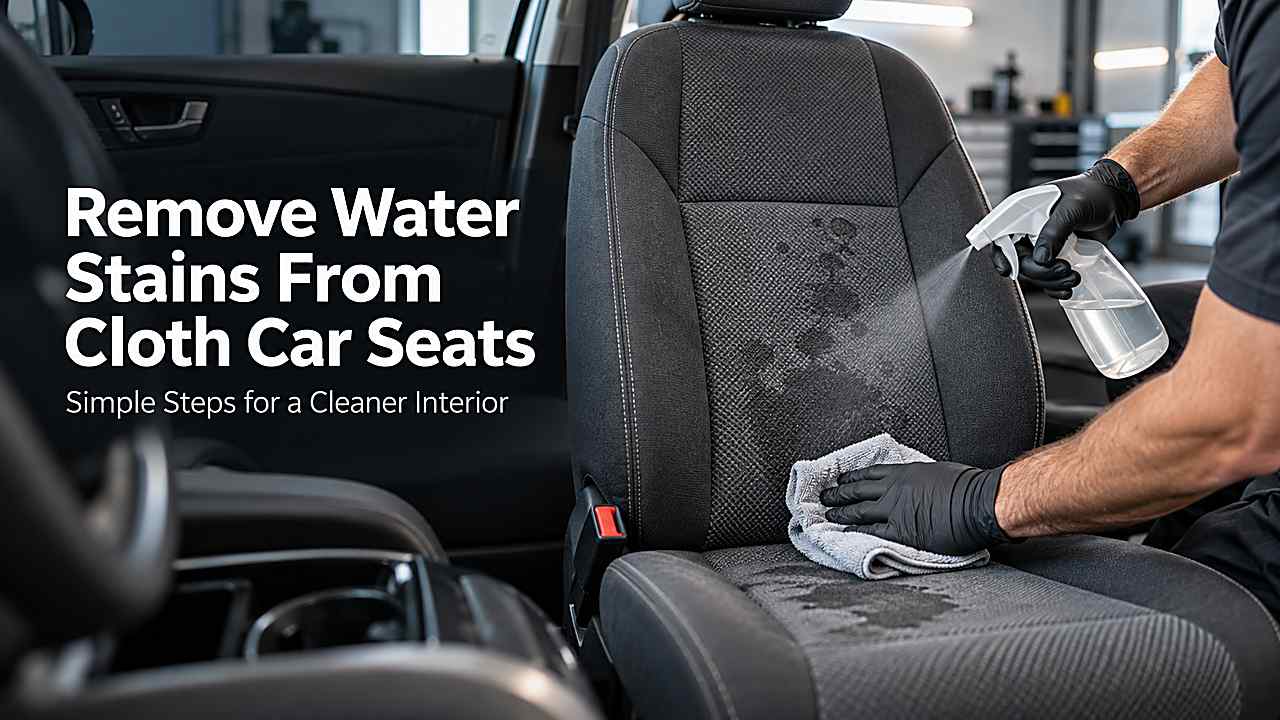
How to remove water stains from cloth car seats sounds simple until the material, contamination, and hidden edges start working against you. Water carries soil and minerals toward the edge of a wet area, then evaporation leaves a visible boundary known as a tide mark. That is why a method that looks effective for the first minute can still leave streaks, residue, odor, or damage after the surface dries.
The goal is to clean water-stained cloth car seats efficiently while preserving woven automotive upholstery and the foam beneath it. A careful process starts with vacuum the seat thoroughly and identify whether the mark is truly water-related or includes food, dye, or another contaminant, then uses the least aggressive combination of tool and cleaner that will solve the actual problem. The sections below explain how to judge the surface, carry out the work, and recognize when a different approach is safer.
Water rings usually disappear when the entire affected fabric section is cleaned and dried evenly. Spotting only the dark edge can move the ring outward instead of removing the residue that created it.
Start by understanding woven automotive upholstery and the foam beneath it
The practical difficulty is not simply visible dirt. In this case, the main contamination is mineral residue, dissolved dirt, and tide marks left as moisture dries unevenly. Water carries soil and minerals toward the edge of a wet area, then evaporation leaves a visible boundary known as a tide mark. That combination explains why a quick wipe often improves appearance without fully solving the issue.
Material behavior matters just as much as the mess itself. Woven automotive upholstery and the foam beneath it can tolerate routine cleaning, but the risk rises when friction, liquid, heat, or chemical strength exceeds what the surface was designed to handle. Seats with occupancy sensors, heaters, ventilation, or unusual fabrics need extra moisture control and may have model-specific cleaning instructions.
A useful way to judge progress is to separate loose contamination from bonded residue. Loose dust or grit should come away with dry methods first, while the remaining film can then be treated with a low-residue upholstery cleaner diluted and used according to the product directions. This sequence keeps dirt from being turned into an abrasive slurry and makes the wet stage more controlled.
Match the tool to the material, not just the mess
Tool choice affects both speed and finish quality. For this job, microfiber towels, a soft upholstery brush, and controlled wet extraction when the fabric allows it gives the best balance of reach and control, while distilled water for a final light rinse when local tap water is mineral-heavy helps with details the main tool cannot reach. The important point is not owning many accessories, but using each one for a specific task.
Cleaner strength should stay proportional to the contamination. A low-residue upholstery cleaner diluted and used according to the product directions is a sensible starting point because it addresses the soil without immediately escalating to harsh chemistry. When a first pass leaves a small amount behind, repeating a gentle method is usually safer than jumping straight to a strong solvent or abrasive tool.
Cross-contamination is easy to overlook. Towels and brushes that have touched greasy trim, wheel products, or heavy grime should not move onto a sensitive interior surface. Clean tools make the final result more predictable and reduce the chance that the ‘streak’ or ‘shine’ seen afterward is actually residue from a previous job.
- Primary tool: microfiber towels, a soft upholstery brush, and controlled wet extraction when the fabric allows it
- Secondary tool: distilled water for a final light rinse when local tap water is mineral-heavy
- Cleaner: a low-residue upholstery cleaner diluted and used according to the product directions
- Main thing to avoid: hard scrubbing, saturating seat sensors or heaters, and repeatedly adding cleaner without removing the dirty solution
Mistakes that can damage woven automotive upholstery and the foam beneath it
The most common mistake is assuming that more product or more force will solve the job faster. Here, the main risk is over-wetting the cushion, spreading dissolved soil, or leaving detergent behind to create another ring. Once that happens, the cleanup can become more difficult than the original contamination and may require repair rather than detailing.
Another weak approach is hard scrubbing, saturating seat sensors or heaters, and repeatedly adding cleaner without removing the dirty solution. These methods often look efficient because they change the surface quickly, but the change may come from residue, abrasion, excess moisture, or altered sheen instead of true cleanliness. A slower, controlled pass is easier to evaluate and easier to stop if the material reacts poorly.
Stopping at the right time is part of good detailing. A stain that is clearly improving can justify another gentle cycle, while fading dye, roughening fibers, tackiness, or a change in gloss means the process should be reassessed. Preserving the material is more important than chasing the last faint mark with an increasingly aggressive method.
A practical method for how to remove water stains from cloth car seats
A controlled sequence keeps the job efficient because each stage prepares the surface for the next one. The process below begins with the least aggressive work and only adds moisture or chemistry after dry contamination has been removed. That order is especially important around seams, electronics, bonded fabrics, and coated surfaces.
1. Set up the material for a safe first pass.
Preparation starts with vacuum the seat thoroughly and identify whether the mark is truly water-related or includes food, dye, or another contaminant. This removes variables that can turn an easy job into a messy one. A quick inspection also reveals damaged trim, loose fabric, open seams, electronics, or specialty materials that need a lighter touch. Dry contamination deserves attention before any liquid is added.
Dust, crumbs, hair, or grit can scratch or smear when trapped under a wet towel. Removing that material first also lets the cleaner contact the actual stain or film instead of fighting through a layer of debris. Throughout this stage, the main priority remains protecting woven automotive upholstery and the foam beneath it while removing mineral residue, dissolved dirt, and tide marks left as moisture dries unevenly.
2. Let the tool and cleaner do the work.
The main cleaning stage is based on clean and lightly dampen a broader section of the panel rather than attacking only the dark edge, then extract or blot evenly. The surface should become cleaner in a controlled way rather than suddenly soaked or heavily scrubbed. Working in small areas makes it easier to see whether the method is improving the surface or simply moving contamination around. Pressure should remain modest because chemistry and dwell time can do much of the work.
If residue persists, a second gentle pass usually makes more sense than increasing force immediately. That approach protects finishes, stitching, adhesives, and delicate texture while still allowing the cleaning to progress. Throughout this stage, the main priority remains protecting woven automotive upholstery and the foam beneath it while removing mineral residue, dissolved dirt, and tide marks left as moisture dries unevenly.
3. Check the result after the moisture is gone.
Finishing is more than cosmetic because leftover moisture and product can create the next problem. Use airflow to dry the seat uniformly and avoid sitting on it until the foam is dry. A clean dry towel or adequate airflow is often the difference between a surface that looks good while wet and one that still looks good an hour later. The final inspection should happen from more than one angle whenever possible.
Changing the light reveals streaks, remaining soil, lifted fibers, or uneven sheen that were not obvious during the wet stage. Small corrections are easiest while the tools are still out and the residue has not had time to dry again. Throughout this stage, the main priority remains protecting woven automotive upholstery and the foam beneath it while removing mineral residue, dissolved dirt, and tide marks left as moisture dries unevenly.
Small habits that reduce future deep cleaning
Maintenance changes the difficulty of the next deep clean. Blotting fresh spills early and drying them evenly makes later tide marks much less likely. Frequent light care removes contamination while it is still near the surface instead of waiting until it has bonded, dried, or migrated into seams and padding.
Storage of cleaning tools matters as well. Microfiber should be washed without fabric softener, brushes should be kept free of grit, and small interior tools should not share a bag with wheel or exterior equipment. That simple separation keeps future cleaning from adding oily residue or abrasive particles to a delicate surface.
The best routine is the one that matches how the vehicle is actually used. Pets, children, beach trips, smoking history, frequent food and drink, or dusty parking conditions all change how quickly contamination returns. Adjusting maintenance to those conditions is more useful than following a rigid calendar.
Frequently Asked Questions
These questions cover the situations that most often change the recommendation for how to remove water stains from cloth car seats. The direct answer comes first, followed by the material and process considerations that matter in practice. When manufacturer instructions conflict with generic detailing advice, the manufacturer guidance should take priority.
Why does plain water leave a stain on cloth seats?
Water can dissolve dirt and minerals already present in the fabric, then deposit them at the edge as the wet area dries. The safest answer depends on the exact material and how deeply the contamination has penetrated. A small test in an inconspicuous area is useful whenever cleaner strength or colorfastness is uncertain.
More liquid is rarely the first solution because excess moisture can move residue into seams, backing, foam, or electronics. A clean final wipe and complete drying also matter because many apparent stains are partly leftover cleaner or uneven moisture.
Should I use distilled water on cloth seats?
Distilled water can be useful for a final light rinse because it adds fewer minerals, especially where tap water is hard. A small test in an inconspicuous area is useful whenever cleaner strength or colorfastness is uncertain. More liquid is rarely the first solution because excess moisture can move residue into seams, backing, foam, or electronics.
A clean final wipe and complete drying also matter because many apparent stains are partly leftover cleaner or uneven moisture. When the material shows damage, discoloration, delamination, or a persistent odor from below the surface, professional help can be more sensible than repeated DIY treatment.
Can an extractor remove water rings?
Controlled extraction often helps because it lifts both dissolved residue and excess moisture, but the seat should not be saturated deeply. More liquid is rarely the first solution because excess moisture can move residue into seams, backing, foam, or electronics. A clean final wipe and complete drying also matter because many apparent stains are partly leftover cleaner or uneven moisture.
When the material shows damage, discoloration, delamination, or a persistent odor from below the surface, professional help can be more sensible than repeated DIY treatment. The safest answer depends on the exact material and how deeply the contamination has penetrated.
Why did the stain get bigger after I cleaned it?
A larger ring usually means the wet area spread beyond the original mark and dried with soil concentrated along the new edge. A clean final wipe and complete drying also matter because many apparent stains are partly leftover cleaner or uneven moisture. When the material shows damage, discoloration, delamination, or a persistent odor from below the surface, professional help can be more sensible than repeated DIY treatment.
The safest answer depends on the exact material and how deeply the contamination has penetrated. A small test in an inconspicuous area is useful whenever cleaner strength or colorfastness is uncertain.
How do I dry cloth seats quickly without causing odor?
Good airflow, moderate warmth, and time are safer than intense heat, while extraction beforehand reduces how much water remains in the foam. When the material shows damage, discoloration, delamination, or a persistent odor from below the surface, professional help can be more sensible than repeated DIY treatment. The safest answer depends on the exact material and how deeply the contamination has penetrated.
A small test in an inconspicuous area is useful whenever cleaner strength or colorfastness is uncertain. More liquid is rarely the first solution because excess moisture can move residue into seams, backing, foam, or electronics.
Conclusion
How to remove water stains from cloth car seats works best when the method respects both the contamination and the material underneath it. Water rings usually disappear when the entire affected fabric section is cleaned and dried evenly. Spotting only the dark edge can move the ring outward instead of removing the residue that created it. The surface should end the process clean, dry, and unchanged in texture or finish rather than simply looking wet or freshly dressed.
The practical next step is to begin with vacuum the seat thoroughly and identify whether the mark is truly water-related or includes food, dye, or another contaminant, then use microfiber towels, a soft upholstery brush, and controlled wet extraction when the fabric allows it and a low-residue upholstery cleaner diluted and used according to the product directions with controlled pressure and moisture. If the material reacts poorly or the contamination clearly extends beneath the visible surface, stopping early is a better decision than escalating blindly.