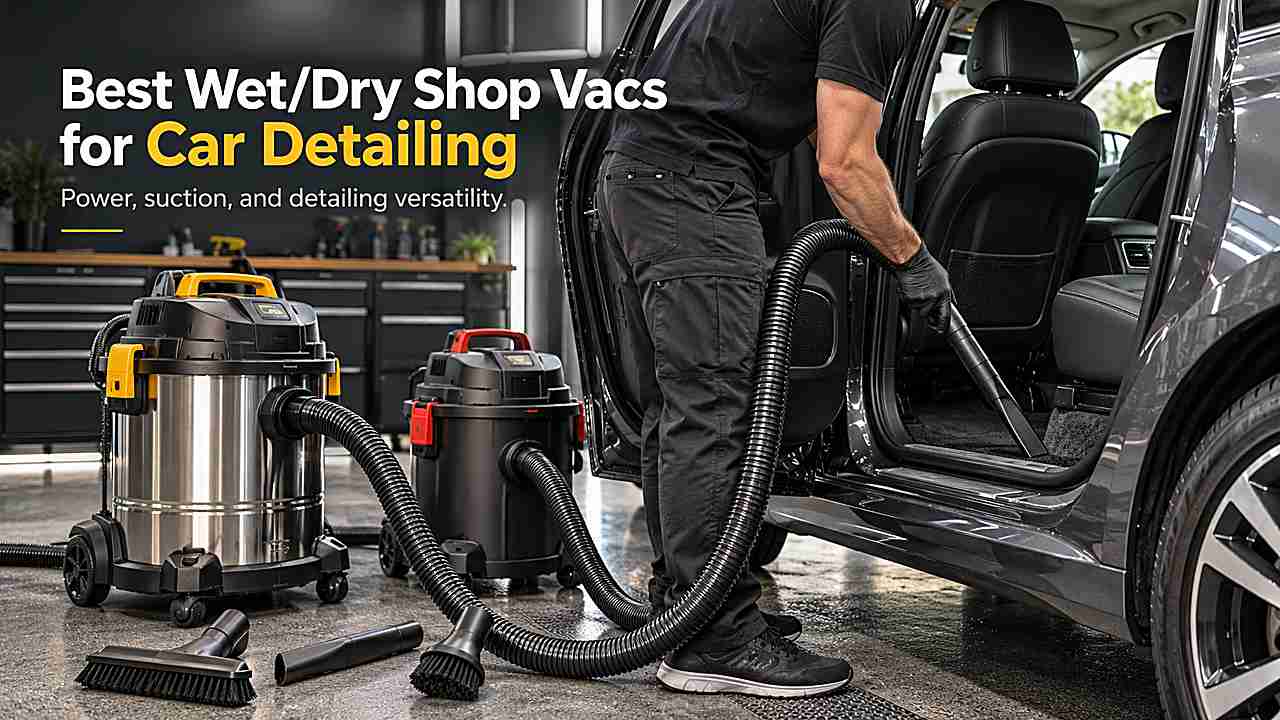
Top rated wet dry shop vacs for car detailing is not a useful shopping question until the job is defined clearly. A product can look excellent in a rating table and still be the wrong choice for the surface, vehicle, pet, garage, or workflow that will actually use it.
This guide compares current options by the details that change real-world performance, then explains where each pick fits and where its trade-offs become important. The aim is to make the shortlist useful after the first week of ownership, not just persuasive on purchase day.
For most detailers, the RIDGID WD4070 is the strongest all-around corded choice because it combines strong airflow, a compact 4-gallon body, a long cord, and a car nozzle. The Milwaukee M18 FUEL PACKOUT 2.5-gallon vacuum is the better premium choice when cordless mobility matters more.
What matters before you buy
The most important specifications are the ones that control the real task. Marketing claims are easier to evaluate once the surface, workload, compatibility limits, and maintenance burden are clear.
Suction that matters in a car, not just peak horsepower
Automotive carpet traps sand, crumbs, hair, and damp debris in ways that expose weak vacuum performance quickly. Airflow, water lift, hose diameter, and nozzle shape are more useful than a peak-horsepower label. A compact machine with strong sealed suction can outperform a larger drum when the nozzle actually reaches under seats. That distinction matters in everyday use because the wrong setup can make a capable product feel disappointing. A small compatibility test also reduces the chance of creating a bigger problem while trying to solve the original one.
Tank size versus portability
Large shop vacs hold more debris but can become awkward beside a vehicle. Four to six gallons is a useful range for many garages, while 2.5-gallon cordless units are easier to move through a cabin. Capacity only helps if the canister remains easy to position without dragging the hose across paint or trim. That distinction matters in everyday use because the wrong setup can make a capable product feel disappointing. A small compatibility test also reduces the chance of creating a bigger problem while trying to solve the original one.
Hose reach and automotive attachments
A proper crevice tool reaches seat rails and console edges, while a low-profile car nozzle covers floor mats efficiently. Long hoses reduce canister movement but can sacrifice some airflow if they are too narrow. Attachment quality can change real detailing performance more than a small difference in motor specification. That distinction matters in everyday use because the wrong setup can make a capable product feel disappointing. A small compatibility test also reduces the chance of creating a bigger problem while trying to solve the original one.
Filtration and wet-pickup setup
Fine interior dust can pass through weak filtration and return to the garage air. A quality cartridge or HEPA-capable setup is useful for dry detailing, while wet pickup requires the filter arrangement specified by the manufacturer. Easy filter access makes switching between dry debris and liquid recovery much less annoying. That distinction matters in everyday use because the wrong setup can make a capable product feel disappointing. A small compatibility test also reduces the chance of creating a bigger problem while trying to solve the original one.
Quick comparison of the strongest options
Each product below wins for a different type of buyer. The table narrows the field quickly, while the detailed notes explain the practical trade-offs that a star rating cannot show.
| Product | Best for | Why it stands out |
| RIDGID WD4070 4-Gallon Portable Wet/Dry Vac | Best overall for car detailing | RIDGID publishes 110 CFM, 49 inches of lift, a 20-foot cord, and an included car nozzle in a compact 4-gallon format. |
| Armor All AA255W 2.5-Gallon Wet/Dry Utility Vac | Best compact budget car vac | Its small canister and car-oriented accessories make it easy to move from footwell to footwell. |
| Milwaukee M18 FUEL PACKOUT 2.5-Gallon Wet/Dry Vacuum | Best cordless premium option | Milwaukee lists 50 CFM, 47 inches of water lift, a HEPA filter, and a 6-foot hose in a battery-powered PACKOUT format. |
| Stanley SL18116P 6-Gallon Wet/Dry Vacuum | Best garage value | Stanley lists 75 CFM, a 6-gallon drum, swivel casters, a blower port, and several useful nozzles. |
| Vacmaster 5-Gallon Wall-Mount Wet/Dry Vacuum | Best space-saving fixed-garage setup | The wall-mounted format keeps the floor clear while giving a dedicated detailing bay convenient hose access. |
The best choices in detail
1. RIDGID WD4070 4-Gallon Portable Wet/Dry Vac: Best overall for car detailing
RIDGID WD4070 4-Gallon Portable Wet/Dry Vac earns the best overall for car detailing position because rIDGID publishes 110 CFM, 49 inches of lift, a 20-foot cord, and an included car nozzle in a compact 4-gallon format. That combination gives it enough performance for sand, pet hair, floor mats, and controlled wet pickup without turning the garage into an obstacle course. The corded design is less convenient than a battery vacuum when the vehicle is parked far from an outlet. Choose it if suction, reach, and compact garage use matter more than cordless freedom. Before buying, confirm the current package contents, compatibility, warranty, and any revised manufacturer directions because bundles and specifications can change over time.
2. Armor All AA255W 2.5-Gallon Wet/Dry Utility Vac: Best compact budget car vac
Armor All AA255W 2.5-Gallon Wet/Dry Utility Vac earns the best compact budget car vac position because its small canister and car-oriented accessories make it easy to move from footwell to footwell. It handles routine crumbs, dust, light pet hair, and small wet messes while remaining easy to store. It gives up tank size and raw performance compared with stronger four- and six-gallon machines. It fits occasional DIY detailers who want wet pickup and basic interior versatility. Before buying, confirm the current package contents, compatibility, warranty, and any revised manufacturer directions because bundles and specifications can change over time.
3. Milwaukee M18 FUEL PACKOUT 2.5-Gallon Wet/Dry Vacuum: Best cordless premium option
Milwaukee M18 FUEL PACKOUT 2.5-Gallon Wet/Dry Vacuum earns the best cordless premium option position because milwaukee lists 50 CFM, 47 inches of water lift, a HEPA filter, and a 6-foot hose in a battery-powered PACKOUT format. Cordless operation is unusually convenient for mobile detailing and parking areas without nearby outlets. The tool becomes expensive if you do not already own M18 batteries and chargers. It is ideal for mobile detailers and owners who value portability. Before buying, confirm the current package contents, compatibility, warranty, and any revised manufacturer directions because bundles and specifications can change over time.
4. Stanley SL18116P 6-Gallon Wet/Dry Vacuum: Best garage value
Stanley SL18116P 6-Gallon Wet/Dry Vacuum earns the best garage value position because stanley lists 75 CFM, a 6-gallon drum, swivel casters, a blower port, and several useful nozzles. The extra tank room is useful when the same machine handles car interiors and general workshop cleanup. The canister takes more floor space and is less nimble around door openings. It suits a home garage where one affordable machine has to perform several jobs. Before buying, confirm the current package contents, compatibility, warranty, and any revised manufacturer directions because bundles and specifications can change over time.
5. Vacmaster 5-Gallon Wall-Mount Wet/Dry Vacuum: Best space-saving fixed-garage setup
Vacmaster 5-Gallon Wall-Mount Wet/Dry Vacuum earns the best space-saving fixed-garage setup position because the wall-mounted format keeps the floor clear while giving a dedicated detailing bay convenient hose access. The vacuum can remain stored and ready instead of being rolled out for every cleanup. It is less useful when the vehicle is cleaned outside the mounted hose range. It makes sense for a permanent garage bay where storage efficiency matters. Before buying, confirm the current package contents, compatibility, warranty, and any revised manufacturer directions because bundles and specifications can change over time.
Why the nozzle can matter more than another gallon of capacity
A flat automotive nozzle keeps the opening close to carpet, which improves pickup on sand and small debris without forcing the operator to press hard. Narrow crevice tools also reach seat-track channels where large shop accessories simply bridge over the mess. In real detailing, those contact-area advantages often matter more than moving from a five-gallon tank to a ten-gallon tank.
The vacuum still needs adequate airflow, but the nozzle determines how much of that airflow reaches the dirt. A good attachment also reduces scraping against plastic seat trim and door sills. For a dedicated car setup, better nozzles can improve the machine more than replacing it.
Cordless versus corded for a detailing workflow
Cordless vacuums are excellent when the vehicle is parked outdoors, in an apartment lot, or far from a convenient outlet. Their biggest limitation is energy storage because heavy suction draws batteries quickly and replacement packs are expensive. Corded units remain the better value for long interior sessions where consistent power matters.
A mobile detailer may happily accept battery cost in exchange for speed between jobs, while a fixed garage usually benefits from corded simplicity. The right choice is less about which technology is newer and more about the way the vehicle is actually cleaned.
Common buying and use mistakes
Most disappointing purchases in this category are not completely useless products. They are capable products matched to the wrong job, or good products used in a way that defeats the feature that made them worth buying.
Buying the biggest drum instead of the best car setup
A huge shop vacuum can have impressive capacity and still be irritating beside a small vehicle. The canister may catch on open doors, the hose may be too stiff, and the included floor nozzle may be useless under seats. Automotive attachments and reach deserve equal weight with motor specs. That distinction matters in everyday use because the wrong setup can make a capable product feel disappointing. A small compatibility test also reduces the chance of creating a bigger problem while trying to solve the original one.
Ignoring filter condition
A loaded cartridge quietly reduces suction and makes the vacuum feel weaker than it is. Fine interior dust can plug filters long before the tank is full. Cleaning or replacing the filter restores airflow and protects the motor. That distinction matters in everyday use because the wrong setup can make a capable product feel disappointing. A small compatibility test also reduces the chance of creating a bigger problem while trying to solve the original one.
Dragging the hose across paint
Vacuum hoses collect garage grit and can mark door sills or exterior paint when they rub repeatedly. Keeping the canister close and routing the hose through the open doorway reduces contact. A clean hose sleeve or towel over a vulnerable sill adds protection. That distinction matters in everyday use because the wrong setup can make a capable product feel disappointing. A small compatibility test also reduces the chance of creating a bigger problem while trying to solve the original one.
Keep suction strong over the life of the vacuum
Filters, hoses, and nozzles should stay clean enough that suction does not quietly disappear over months of use. Pet hair and fine dust can collect where the tank still looks nearly empty, so airflow should be checked before assuming the motor has weakened. A small organizer for crevice tools also prevents the most useful automotive attachment from disappearing into the garage.
Consumables belong in the ownership cost. Filters, bags, batteries, and replacement hoses can make an inexpensive vacuum costly if proprietary parts are difficult to find. A machine with ordinary, available accessories often delivers better long-term value than a slightly stronger model with poor support.
Frequently Asked Questions
These questions cover the decisions that usually remain after the shortlist has been narrowed down and the basic trade-offs are clear.
How much suction does a shop vac need for car detailing?
There is no single minimum because airflow, water lift, hose diameter, filter condition, and nozzle design work together. Sand and embedded debris benefit from higher airflow and good sealed suction, while crumbs and surface dust are easier. A narrow automotive nozzle can improve real pickup more than a small difference in published motor power. That distinction matters in everyday use because the wrong setup can make a capable product feel disappointing. A small compatibility test also reduces the chance of creating a bigger problem while trying to solve the original one.
Is a 2.5-gallon wet dry vac big enough for a car?
Yes, a 2.5-gallon machine is large enough for routine interior detailing and small wet spills. The advantage is that it can sit beside an open door or move easily between seats. The downside is more frequent emptying during heavy wet extraction or garage cleanup. That distinction matters in everyday use because the wrong setup can make a capable product feel disappointing. A small compatibility test also reduces the chance of creating a bigger problem while trying to solve the original one.
Can I use a wet dry shop vac as a carpet extractor?
It can recover cleaning solution after you spray and agitate upholstery separately, but it is not a true extractor because it does not meter solution through the same tool. Moisture control therefore depends entirely on technique. Deeply contaminated seats and carpet are easier to manage with a purpose-built extractor. That distinction matters in everyday use because the wrong setup can make a capable product feel disappointing. A small compatibility test also reduces the chance of creating a bigger problem while trying to solve the original one.
Do I need a HEPA filter for car detailing?
A HEPA filter is not mandatory for ordinary crumbs and sand, but it is useful when the vacuum also handles fine dust. Better filtration reduces the amount of small particulate blown back into the garage. The filter still needs maintenance because a clogged premium filter can reduce suction noticeably. That distinction matters in everyday use because the wrong setup can make a capable product feel disappointing. A small compatibility test also reduces the chance of creating a bigger problem while trying to solve the original one.
Is a larger hose always better?
No. A larger hose can move bulky debris but is harder to maneuver under seats and around consoles. Smaller automotive hoses and nozzles are often easier to control and can maintain useful velocity at the opening. The ideal setup balances airflow with access. That distinction matters in everyday use because the wrong setup can make a capable product feel disappointing.
Conclusion
The strongest choice for top rated wet dry shop vacs for car detailing depends on the exact job and the conditions in which the product will be used. The best overall pick is the safest starting point, but another option may be better when portability, compatibility, finish, capacity, or maintenance matters more.
Check the current manufacturer specifications before buying, then use the product within its stated limits from the first session. A well-matched product maintained properly will usually outperform a more expensive option that was chosen for features the job never needed.