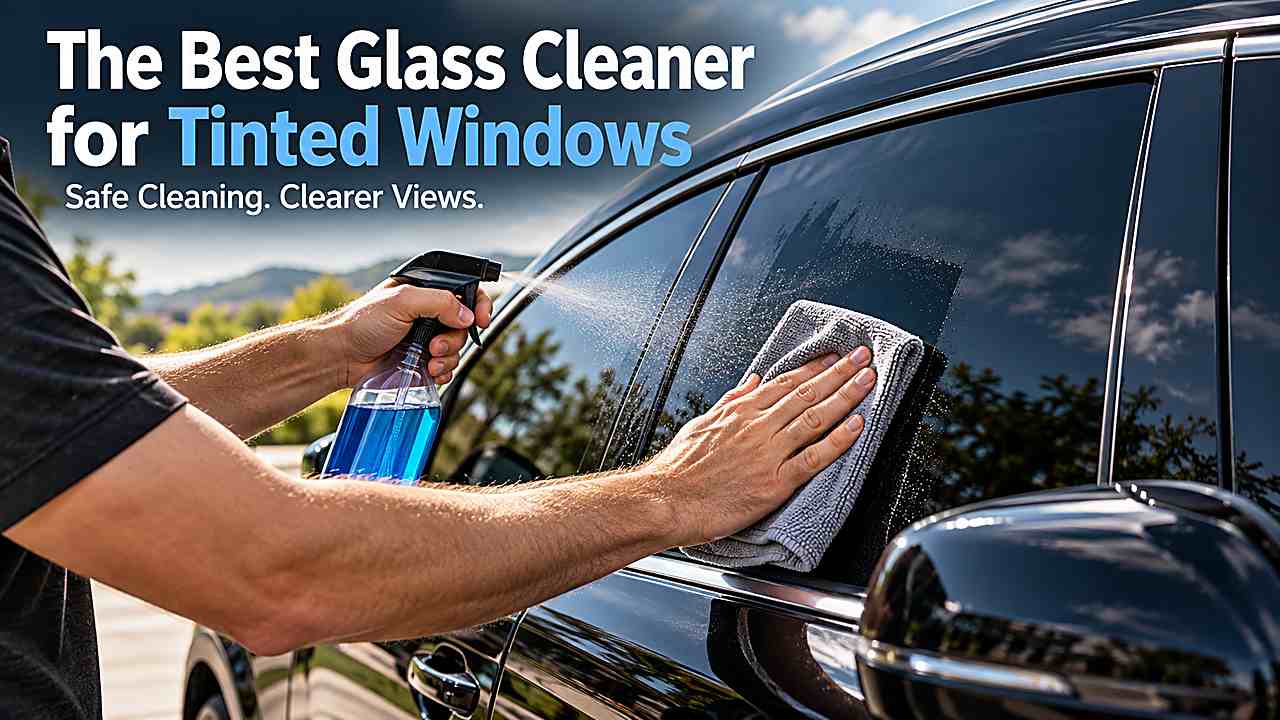
A glass cleaner can look perfect on exterior windows and still be a poor choice for aftermarket tint on the inside. Tint compatibility, residue, towel behavior, and the cleaner’s ability to remove oily windshield haze are the details that separate a safe automotive product from an ordinary household spray.
This guide compares current options by explicit tint-safety claims, streak control, application format, and real automotive use. The goal is clear glass without ammonia concerns, greasy film, or unnecessary liquid around tint edges and dashboard electronics.
Meguiar’s Perfect Clarity is the best overall pick because current testing rated it highly and Meguiar’s explicitly states that it is ammonia-free and safe on window tint. Invisible Glass is the best residue-free alternative, while Chemical Guys and Adam’s are strong tint-safe enthusiast options.
What matters most before you buy
The product category becomes much easier to compare once the decision is reduced to the few features that actually change results. These are the factors worth checking before price or review count.
Tint safety needs an explicit compatibility claim
Aftermarket window film is bonded to the inside of the glass and deserves more caution than ordinary exterior glass. Ammonia-free chemistry is an important starting point, but the clearest buying signal is a manufacturer statement that the cleaner is safe for tinted windows.
Factory privacy glass is usually colored within the glass itself, while aftermarket film is a separate material that can be more sensitive. When the tint installer provides care instructions, those instructions should override a generic cleaner recommendation.
A good automotive glass cleaner should evaporate without leaving film
Streaks are often caused by residue rather than a lack of cleaning power. Soaps, fragrances, protectants, and excess product can leave a film that becomes especially obvious at night when headlights hit the windshield.
Fast-flashing formulas are useful inside the car because they reduce how long the towel has to chase moisture. The cleaner should make the final pass easier instead of demanding repeated buffing to remove its own residue.
Foam and trigger sprays solve different physical problems
A trigger spray gives precise dosing and is easy to apply to a microfiber towel before working near dashboard electronics. Foaming aerosols cling to vertical glass and can stay in place longer on an upright side window or steep windshield.
Neither format is automatically better for tint. The more important issue is how much product reaches the glass and whether overspray lands on trim, screens, or headliner fabric.
Heavy smoke film needs cleaner towels as much as stronger chemistry
Interior windshield haze can contain plasticizer film, body oils, smoke residue, and fine dust. A cleaner may break that film effectively, but a saturated towel can simply spread it across the next section.
Using one towel for the cleaning pass and a second dry glass towel for the final buff often matters more than changing brands. Good glass cleaning is a system of chemistry, towel, and technique.
Quick comparison of the best options
Each recommendation below solves a slightly different version of the same problem. The table is a fast shortlist, while the detailed sections explain why one option may fit your routine better than another.
| Product | Best for | Why it stands out |
| Meguiar’s Perfect Clarity Glass Cleaner | Best overall | Meguiar’s states that Perfect Clarity is ammonia-free, safe on window tint, anti-hazing, and formulated for road film, smoker’s film, grease, bugs, and grime. |
| Invisible Glass Premium Glass Cleaner | Best residue-free option | Stoner states that Invisible Glass contains no ammonia and is safe for both factory and aftermarket tinted windows, with no soaps, scents, or dyes intended to remain behind. |
| Chemical Guys Signature Series Glass Cleaner | Best enthusiast all-surface choice | Chemical Guys explicitly labels the formula ammonia-free and safe for window tint, while also listing compatibility with screens and clear plastics. |
| Griot’s Garage Foaming Glass Cleaner | Best foaming option | Griot’s Garage states that its foaming glass cleaner is dye-free, ammonia-free, safe on all tinted windows, and designed to dissolve smoke film, salt, grime, and bug residue. |
| Adam’s Glass Cleaner | Best premium trigger-spray alternative | Adam’s explicitly states that its glass cleaner is safe on factory and aftermarket tint, ammonia-free, and designed for streak-free optical clarity. |
The best choices in detail
1. Meguiar’s Perfect Clarity Glass Cleaner: Best overall
Meguiar’s states that Perfect Clarity is ammonia-free, safe on window tint, anti-hazing, and formulated for road film, smoker’s film, grease, bugs, and grime. Car and Driver’s 2026 testing also selected Meguiar’s Perfect Clarity as its best overall automotive glass cleaner, which supports the product beyond manufacturer claims alone. A strongly contaminated windshield may still need two towels or a separate initial degreasing pass before the final streak-free wipe.
Choose it if you want one widely available cleaner for factory glass, aftermarket tint, and routine windshield haze. Before buying, confirm the current package, size, compatibility, and care instructions because manufacturers can revise listings and bundles over time.
2. Invisible Glass Premium Glass Cleaner: Best residue-free option
Stoner states that Invisible Glass contains no ammonia and is safe for both factory and aftermarket tinted windows, with no soaps, scents, or dyes intended to remain behind. That stripped-down residue philosophy is especially useful for night-driving clarity because leftover film can turn into glare. The trigger-spray version can mist onto dashboard trim if sprayed directly at the inside windshield, so towel application gives better control.
It suits drivers who care most about a clean, neutral finish with no added protection or fragrance. Before buying, confirm the current package, size, compatibility, and care instructions because manufacturers can revise listings and bundles over time.
3. Chemical Guys Signature Series Glass Cleaner: Best enthusiast all-surface choice
Chemical Guys explicitly labels the formula ammonia-free and safe for window tint, while also listing compatibility with screens and clear plastics. The broad compatibility is useful in a modern cabin where glass, displays, and gloss trim sit close together. A product that is safe on several surfaces still should not be sprayed directly into screen edges or electronic controls.
It fits owners who prefer one detailing-brand cleaner for interior and exterior glass plus occasional screen cleaning. Before buying, confirm the current package, size, compatibility, and care instructions because manufacturers can revise listings and bundles over time.
4. Griot’s Garage Foaming Glass Cleaner: Best foaming option
Griot’s Garage states that its foaming glass cleaner is dye-free, ammonia-free, safe on all tinted windows, and designed to dissolve smoke film, salt, grime, and bug residue. The foam stays on vertical glass longer than a thin liquid, which can help on side windows and tall SUV glass. Aerosol format is less convenient for owners who prefer refillable trigger bottles or bulk concentrate.
It is a strong choice when cling and controlled dwell matter more than minimal packaging. Before buying, confirm the current package, size, compatibility, and care instructions because manufacturers can revise listings and bundles over time.
5. Adam’s Glass Cleaner: Best premium trigger-spray alternative
Adam’s explicitly states that its glass cleaner is safe on factory and aftermarket tint, ammonia-free, and designed for streak-free optical clarity. The trigger format makes it easy to spray the towel rather than the glass when working close to screens and trim. The formula includes a light protective or slickness component, which some users may not want before applying a separate glass coating.
It suits enthusiasts who want tint-safe cleaning with a slick, polished feel afterward. Before buying, confirm the current package, size, compatibility, and care instructions because manufacturers can revise listings and bundles over time.
The safest way to clean aftermarket tint is usually a two-towel method
The interior side of tinted glass should be treated as a delicate film rather than bare household window glass. A clean microfiber glass towel lightly dampened with a tint-safe product can remove fingerprints and haze without flooding the edges.
A second dry towel then lifts the remaining moisture before it becomes a streak. Light pressure is usually enough because aggressive scrubbing adds risk without improving the chemistry.
Tint edges deserve special attention. Soaking the border of an older film can encourage contamination or moisture to collect near lifting edges, and a razor blade should never be used on aftermarket film.
If the tint is bubbling, peeling, or already scratched, cleaning cannot repair it. The goal is clarity without making existing film damage worse.
Streak-free glass depends on the towel and the working environment
Even an excellent cleaner can streak on hot glass or under direct sun because the liquid evaporates before the towel has time to level it. Shade and a cool windshield give the cleaner predictable working time.
A dedicated low-lint glass towel is also less likely to carry wax, tire dressing, or interior protectant residue from a previous job. Cross-contaminated towels are a frequent cause of mysterious smears.
One useful technique is to wipe the interior glass horizontally and the exterior glass vertically. If a streak remains, its direction immediately reveals which side needs another pass. That simple habit saves repeated guessing on a windshield that looks perfect from one angle and hazy from another.
When a tint-safe cleaner is not enough
Tint-safe glass cleaner is designed for ordinary haze, fingerprints, road film, and routine grime. Mineral etching, adhesive residue, overspray, or damaged tint are different problems and may need a specialty process rather than a stronger dose of the same cleaner. A product that is gentle enough for routine tint maintenance should not be expected to polish etched glass or repair failing film.
If the exterior glass has hard-water rings that survive normal cleaning, treat that contamination separately with a glass-compatible mineral-removal process. If the problem is on the tint film itself, avoid abrasives and solvents unless the film manufacturer allows them. Knowing when to stop using a general cleaner protects both the glass and the tint.
Common buying and use mistakes
Most disappointing results come from a mismatch between a capable product and the way it is used. These mistakes are worth avoiding because they create extra work even when the product itself is good.
Assuming every ammonia-free household cleaner is automatically tint safe
Ammonia-free chemistry is a good sign, but tint compatibility involves the entire formula, not one missing ingredient. Automotive products with an explicit tint-safe statement remove that uncertainty.
Household cleaners may also contain fragrances, surfactants, or additives that leave film on a windshield. A purpose-made automotive cleaner is the safer default for expensive aftermarket film.
Using one dirty microfiber towel for the whole windshield
A towel loaded with smoke film and skin oil stops removing contamination and begins redistributing it. The glass may look clean while wet and reveal haze as soon as it dries.
Folding the towel into clean faces extends its useful area, but heavily dirty glass often needs a second towel. Final buffing should always happen with a clean, dry surface of the cloth.
Spraying heavily into the dashboard and headliner area
Direct windshield spraying can send cleaner onto speaker grilles, dashboard electronics, pillar trim, and headliner fabric. Those surfaces may not share the same chemical compatibility as glass.
Spraying the towel gives more control and still provides enough product for routine cleaning. A few light applications are better than one soaking pass.
How to get better long-term value from the product
Glass-cleaning towels should be kept separate from wax, tire, and interior-protectant towels because invisible residue transfers easily. A towel that once buffed a greasy dressing can make a premium glass cleaner look terrible. Washing dedicated glass towels with a residue-free microfiber detergent and avoiding fabric softener usually improves consistency more than buying another bottle.
The cleaner itself should stay tightly closed and out of extreme vehicle heat when the manufacturer recommends indoor storage. Trigger sprayers and aerosol valves are consumable hardware, so replacing a poor sprayer can restore control without discarding usable product. Good storage makes the cleaner easier to evaluate on its actual chemistry.
Frequently Asked Questions
These questions cover the practical decisions that usually remain after the shortlist has been narrowed down.
Is ammonia always bad for tinted car windows?
Ammonia is widely avoided on aftermarket window film because it can contribute to discoloration, drying, or adhesive problems depending on the tint construction. That is why major automotive glass-cleaner brands emphasize ammonia-free formulas.
Factory privacy glass is different because the color may be part of the glass itself rather than an applied film. Even so, an explicitly tint-safe automotive cleaner is the simplest choice when you are unsure what type of tint is installed.
Can I use Invisible Glass on aftermarket tint?
Yes. Stoner states that Invisible Glass is safe for factory-tinted and aftermarket-tinted windows when used as directed. The product is also ammonia-free and formulated without soaps, scents, or dyes that can leave residue.
A clean microfiber towel and light application still matter for a streak-free result. Damaged or peeling film should be cleaned more cautiously than healthy tint.
Is Sprayway safe on tinted windows?
Sprayway states that its current glass cleaner is ammonia-free and safe for automotive glass and OEM tints. For aftermarket tinted windows, the company advises testing in an inconspicuous area before broader use.
That makes it less straightforward than products that explicitly claim aftermarket-tint compatibility. Owners with expensive film may prefer Meguiar’s, Invisible Glass, Chemical Guys, Griot’s, or Adam’s for clearer guidance.
Why does the inside of my windshield keep looking greasy?
Interior haze often comes from plasticizer vapors, skin oils, smoke residue, and ventilation deposits rather than ordinary dust. A single wipe can smear those contaminants into a thinner film instead of removing them.
Using a fresh towel face, a dedicated automotive glass cleaner, and a final dry buff usually improves the result. If the haze returns quickly, interior materials or smoking can be contributing continuously.
Can a tint-safe glass cleaner damage a ceramic glass coating?
Most mild tint-safe cleaners are unlikely to behave like strong mineral removers or abrasive polishes, but coating compatibility still depends on the formula and the coating manufacturer. Some cleaners include slickness or protective additives that can change water behavior temporarily.
A coating-maintenance product may be preferable when preserving a specialty glass coating is the top priority. When in doubt, check the coating maker’s care instructions before switching cleaners.
Conclusion
The best tint-safe glass cleaner should leave the window optically clear without asking you to trade safety for cleaning strength. Meguiar’s Perfect Clarity is the strongest all-around starting point, while Invisible Glass is especially appealing if you want a simple residue-free formula with explicit aftermarket-tint compatibility. Work on cool glass with two clean towels, and follow the tint installer or vehicle manufacturer first when older, peeling, or specialty film has its own care requirements.