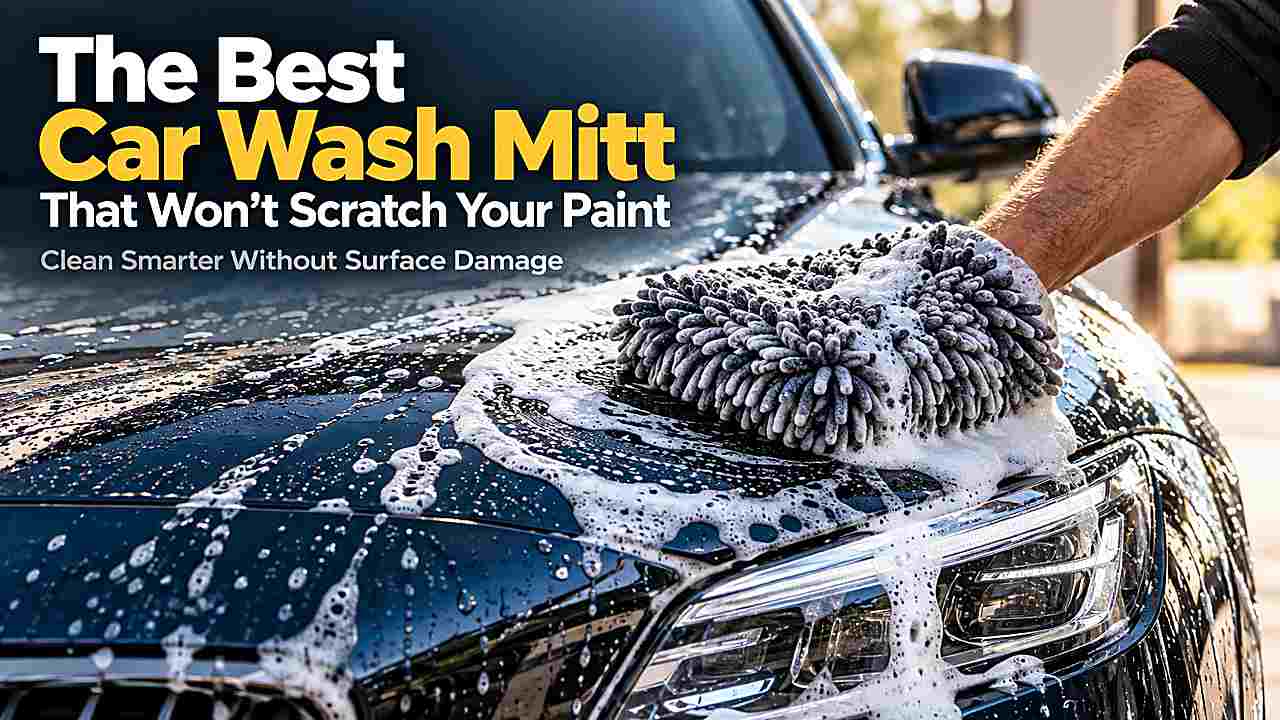
No wash mitt can make a gritty contact wash literally scratch-proof, but the right material and technique can reduce the risk dramatically. Deep pile, good dirt release, secure hand control, and proper maintenance matter far more than a “swirl-free” claim printed on the package.
This guide compares current mitts by fiber design, lubrication capacity, dirt release, control on vertical panels, and care requirements. It also explains the wash technique around the mitt, because even premium microfiber or Merino wool can mar paint if it is loaded with grit and dragged under pressure.
The Rag Company Cyclone Ultra Wash Mitt is the strongest all-around recommendation because its edgeless microfiber design is built to release dirt easily and work with foam, bucket, or rinseless washing. CARPRO’s Merino Wool Mitt is the gentlest premium option for very soft or dark paint.
What matters most before you buy
The product category becomes much easier to compare once the decision is reduced to the few features that actually change results. These are the factors worth checking before price or review count.
Pile depth is what keeps grit away from the clear coat
A flat sponge leaves abrasive particles at the contact surface, while deep microfiber or wool gives dirt somewhere to move away from paint. That does not make any mitt literally scratch-proof, but it lowers the risk when the wash technique is also sound.
The mitt should hold enough solution to stay lubricated without becoming so heavy that it drags across the panel. Deep, soft pile is the first feature to look for on swirl-sensitive paint.
A safe mitt has to release dirt easily in the rinse bucket
Capturing grit is useful only if the mitt gives it up before the next panel. Dense fibers that refuse to rinse clean can carry the same particles around the vehicle.
Rinseless-wash users should care about release characteristics even more because the mitt may be reused through several sections. A light-colored or visually inspectable mitt can also make contamination easier to notice before it touches paint again.
Control matters on mirrors, curves, and vertical panels
A mitt that slips off the hand or folds over itself can create unexpected pressure at the edge of a panel. Internal dividers, cuffs, and ergonomic shapes make it easier to keep light, even contact.
Oversized mitts cover large roofs quickly but can feel clumsy around mirrors and bumpers. The safest tool is the one the user can keep flat and controlled rather than the one with the largest surface area.
Maintenance determines whether a soft mitt stays safe
Microfiber can trap grit, wax, and road oil long after the wash looks finished. A mitt that is not rinsed and laundered properly can become more dangerous than a cheaper new one.
Wool requires even more care because natural fibers can mat, shed, or develop odor if stored wet. Paint safety continues after the wash bucket is emptied.
Quick comparison of the best options
Each recommendation below solves a slightly different version of the same problem. The table is a fast shortlist, while the detailed sections explain why one option may fit your routine better than another.
| Product | Best for | Why it stands out |
| The Rag Company Cyclone Ultra Wash Mitt | Best overall | The Rag Company uses a proprietary microfiber blend, an edgeless design, a twist-loop liner, and an internal layout intended to improve grip and help contaminants release in the bucket. |
| CARPRO Merino Wool Wash Mitt | Best for delicate or dark paint | CARPRO uses 100-percent Merino wool and specifically positions the mitt as an extremely gentle wash tool, with a hand pocket intended to improve control and drying. |
| Chemical Guys Chenille Microfiber Wash Mitt | Best budget pick | Chemical Guys uses a 70/30 microfiber blend with deep chenille noodles designed to hold suds and trap abrasive dirt away from the paint surface. |
| GYEON Q2M Smoothie EVO | Best premium synthetic alternative | GYEON’s Smoothie EVO combines three fiber types, an edgeless design, a secure welt, and very dense microfiber intended to glide while collecting dirt safely. |
| Meguiar’s Microfiber Wash Mitt X3002 | Best widely available mainstream option | Meguiar’s describes the X3002 as an extra-thick microfiber mitt that lifts and traps dirt, carries a large amount of wash solution, and supports swirl-free washing. |
The best choices in detail
1. The Rag Company Cyclone Ultra Wash Mitt: Best overall
The Rag Company uses a proprietary microfiber blend, an edgeless design, a twist-loop liner, and an internal layout intended to improve grip and help contaminants release in the bucket. The mitt works for foam, traditional bucket washing, and rinseless methods, making it unusually versatile for owners who use more than one wash style. Its premium price is much higher than a basic chenille mitt, so casual washers may not need the extra refinement.
Choose it for soft paint, dark colors, coated vehicles, or anyone who values control and easy rinsing. Before buying, confirm the current package, size, compatibility, and care instructions because manufacturers can revise listings and bundles over time.
2. CARPRO Merino Wool Wash Mitt: Best for delicate or dark paint
CARPRO uses 100-percent Merino wool and specifically positions the mitt as an extremely gentle wash tool, with a hand pocket intended to improve control and drying. Natural wool carries a large amount of wash solution and glides very smoothly when the surface is properly pre-rinsed. Wool demands careful hand cleaning, thorough drying, and more attention to storage than synthetic microfiber.
It is a premium choice for garage-kept vehicles, black paint, and owners willing to maintain natural fibers correctly. Before buying, confirm the current package, size, compatibility, and care instructions because manufacturers can revise listings and bundles over time.
3. Chemical Guys Chenille Microfiber Wash Mitt: Best budget pick
Chemical Guys uses a 70/30 microfiber blend with deep chenille noodles designed to hold suds and trap abrasive dirt away from the paint surface. The mitt is inexpensive enough to replace regularly and is machine washable, which makes safe maintenance realistic for everyday drivers. The thick noodles can take longer to dry and may feel bulky around narrow trim.
It is the best low-cost entry point for owners moving away from flat sponges or old wash brushes. Before buying, confirm the current package, size, compatibility, and care instructions because manufacturers can revise listings and bundles over time.
4. GYEON Q2M Smoothie EVO: Best premium synthetic alternative
GYEON’s Smoothie EVO combines three fiber types, an edgeless design, a secure welt, and very dense microfiber intended to glide while collecting dirt safely. The blend gives it more cleaning ability than a very soft single-purpose mitt while retaining a premium feel on paint. It is hand-wash-only and costs considerably more than mainstream microfiber options.
It suits enthusiasts who want a soft synthetic mitt without the care requirements of natural wool. Before buying, confirm the current package, size, compatibility, and care instructions because manufacturers can revise listings and bundles over time.
5. Meguiar’s Microfiber Wash Mitt X3002: Best widely available mainstream option
Meguiar’s describes the X3002 as an extra-thick microfiber mitt that lifts and traps dirt, carries a large amount of wash solution, and supports swirl-free washing. The comfortable cuff and soft lining make it easy to control on daily-driver paint. It lacks some of the refined edgeless or multi-fiber design features found on newer premium mitts.
It remains a practical choice for owners who want a familiar, easily replaced wash mitt from a major automotive brand. Before buying, confirm the current package, size, compatibility, and care instructions because manufacturers can revise listings and bundles over time.
No wash mitt can compensate for a dirty-panel washing method
The mitt touches whatever remains on the paint after the pre-rinse, so reducing loose grit before contact is one of the most important steps in scratch prevention. Mud, road salt, and sandy contamination should be rinsed thoroughly before the mitt reaches the panel.
Pre-wash foam can help soften traffic film, but it does not eliminate the need for careful contact washing. The safer wash begins before the mitt ever touches paint.
During the contact stage, the mitt should move in controlled passes with plenty of shampoo lubrication. Heavy circular scrubbing does not clean more intelligently; it simply increases the number of directions in which a trapped particle can mark the clear coat. Working from cleaner upper panels toward dirtier lower areas also keeps the wash media cleaner for longer.
One mitt for paint and another for the dirty lower zones is a smart upgrade
The rear bumper, rocker panels, lower doors, and wheel-adjacent areas carry more grit than the roof and upper body. Using the same mitt everywhere can load the fibers with contamination and then move that grit back to cleaner paint.
A second clearly different mitt for lower zones costs less than correcting wash-induced swirls later. Wheels should have completely separate tools because brake dust is especially abrasive.
Color coding makes that separation easier. For example, a light or premium mitt can stay dedicated to paint while a darker budget mitt handles lower bodywork.
The system matters more than owning a large collection of expensive products. Good tool separation simply lowers the chance of cross-contamination.
Common buying and use mistakes
Most disappointing results come from a mismatch between a capable product and the way it is used. These mistakes are worth avoiding because they create extra work even when the product itself is good.
Calling any mitt scratch proof
No wash media can guarantee that paint will never scratch because the abrasive material usually comes from the dirt on the vehicle, not from the soft fiber itself. A safe mitt reduces risk by lifting particles into deep pile and holding lubrication.
Poor rinsing, heavy pressure, and contact on a gritty panel can still create marring. Scratch prevention is a process, not a label printed on the package.
Washing wheels and paint with the same mitt
Brake dust contains hard particles that should never be carried from a wheel onto clear coat. Even a thorough bucket rinse may not remove every embedded particle from deep microfiber.
Wheel mitts and brushes should stay completely separate from paint media. This is one of the easiest contamination risks to eliminate.
Machine drying a wool mitt or using fabric softener on microfiber
Natural wool can shrink, mat, or deteriorate with aggressive heat, while microfiber can lose absorbency and cleaning behavior when coated with fabric softener. The manufacturer care instructions should be followed rather than treating wash media like household laundry.
Low heat or air drying is safer for many microfiber tools, and wool often needs gentle hand care. A mitt that feels stiff or contaminated should not return to delicate paint.
How to get better long-term value from the product
Wash mitts should be thoroughly rinsed immediately after use so grit does not dry inside the pile. Microfiber mitts generally benefit from a dedicated microfiber detergent and no fabric softener, while wool mitts need gentler hand care and complete air drying. If a mitt falls on the driveway, it should be washed before it returns to paint rather than being rinsed quickly and trusted.
Retiring a worn mitt early is inexpensive insurance compared with correcting swirl marks. An older mitt can move to door jambs, wheel arches, or other less delicate areas once the fibers become matted. That second life keeps useful tools out of the trash without asking compromised wash media to touch the most visible paint.
Frequently Asked Questions
These questions cover the practical decisions that usually remain after the shortlist has been narrowed down.
Can a microfiber wash mitt still scratch paint?
Yes. Microfiber itself is soft, but trapped grit can scratch when pressure drags it across clear coat. The mitt should be rinsed frequently, used with adequate shampoo lubrication, and replaced if it becomes contaminated or damaged.
Pre-rinsing the vehicle also reduces the amount of hard material the mitt has to handle. Safe technique is what turns a soft mitt into a low-risk wash tool.
Is lambswool or microfiber safer for black paint?
High-quality lambswool or Merino wool can glide extremely gently on well-maintained paint, which is why premium wool mitts are popular for dark show cars. Microfiber is easier to wash, inspect, and maintain consistently.
A neglected wool mitt can be riskier than a clean microfiber mitt. For most daily drivers, premium microfiber offers the best balance of safety and easy care.
How many wash mitts should I use on one car?
One clean mitt can work on a lightly dirty vehicle if it is rinsed often, but two or more mitts reduce cross-contamination. Many careful owners reserve one mitt for upper paint and another for lower dirty areas.
Wheels should always have separate tools. Multiple mitts are especially useful for very dirty winter or off-road vehicles.
How often should I replace a car wash mitt?
There is no fixed mileage or month interval because wear depends on washing frequency, dirt level, and laundry care. Replace the mitt when fibers become matted, stiff, stained with oily contamination, or difficult to rinse clean.
Torn cuffs or exposed backing are also reasons to retire it from paint. Old mitts can be reassigned to door jambs or other lower-risk areas.
Is a wash pad safer than a mitt?
A wash pad can be equally safe if it uses deep clean fibers and the user can control it without dropping it. Some people prefer pads because they rinse faster and do not trap as much water inside a hand pocket.
Mitts provide stronger grip on vertical panels. The safer format is the one that stays clean, lubricated, and under light control throughout the wash.
Conclusion
The best car wash mitt that wont scratch paint is really the mitt that gives dirt somewhere to move while you keep pressure light and lubrication high. The Rag Company Cyclone Ultra is the strongest all-around choice, while CARPRO Merino Wool is a premium option for very delicate or dark finishes. Pre-rinse heavy contamination, keep wheel tools separate, rinse the mitt often, and retire it from paint once the fibers become matted or contaminated because those habits reduce wash-induced marring more reliably than any scratch-free claim.