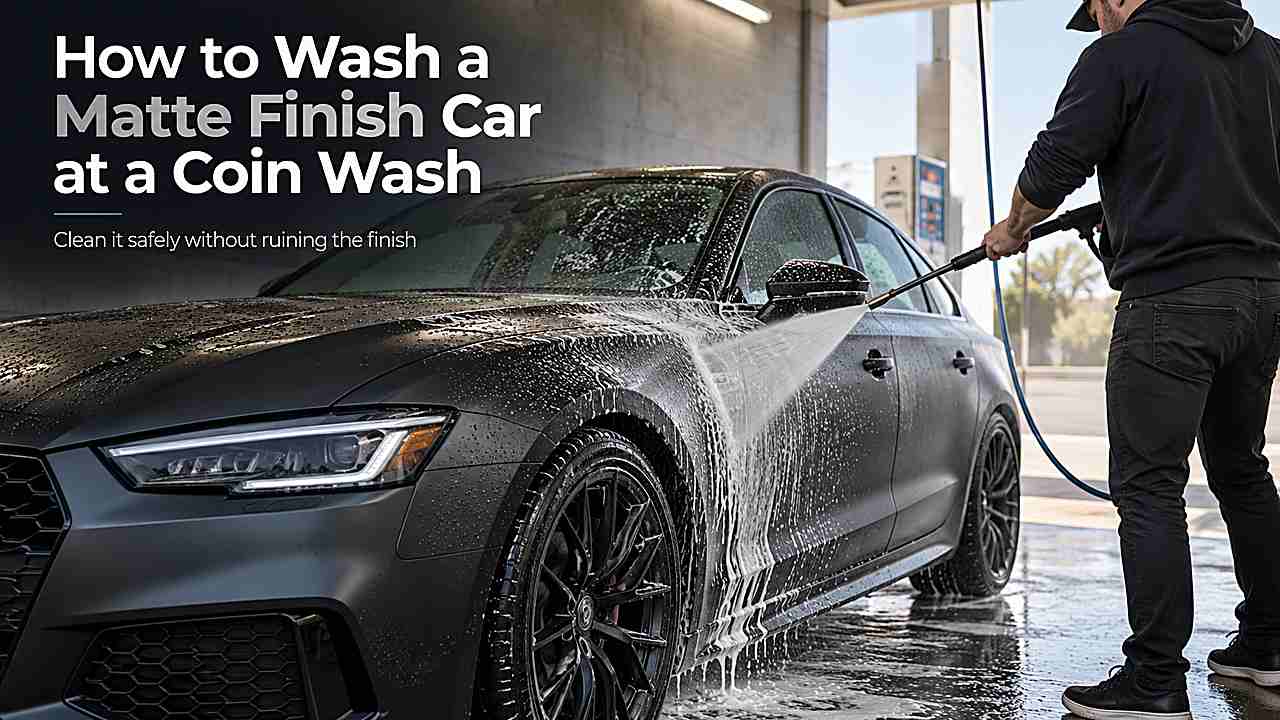
A coin wash can be useful for a matte or satin car because pressure rinsing removes dirt without requiring a driveway. The challenge is that many self-service chemicals are formulated for conventional glossy paint and may contain waxes, gloss enhancers, or strong cleaners you would not choose for a matte finish.
The safest plan is to minimize unknown chemistry, avoid abrasive shared brushes, and use only products you know are approved for matte paint when contact cleaning is necessary.
You can wash a matte finish car at a coin wash, but use the bay conservatively: pre-rinse, avoid wax and gloss-enhancing settings, skip the communal brush on paint, use matte-safe soap if personal products are allowed, rinse thoroughly, and dry with clean microfiber or filtered air.
Why matte paint needs a different wash strategy
Matte and satin finishes are intentionally textured to scatter light rather than reflect it like glossy paint. Abrasive polishing, conventional waxes, gloss enhancers, and aggressive rubbing can change that surface appearance and create shiny patches that are difficult or impossible to blend.
For that reason, treat every product at a coin wash as unknown unless the label clearly says it is safe for matte or low-gloss paint. A plain rinse is safer than an unidentified wax, sealant, gloss conditioner, or brush loaded with residue from previous vehicles.
Paint manufacturer guidance for low-gloss finishes generally emphasizes non-abrasive cleaning and products made specifically for matte surfaces. That makes product selection more important at a public bay, where the exact formulation in each setting may not be obvious.
Which coin-wash settings are safest for matte paint?
The safest settings are usually the simplest: plain water rinse, a clearly identified compatible soap, and spot-free rinse. Avoid any setting labeled wax, shine, polish, gloss, protectant, or clear-coat conditioner unless your matte-paint or coating manufacturer explicitly approves it.
| Bay setting | Matte-paint approach |
|---|---|
| High-pressure rinse | Usually useful with sensible distance |
| Presoak/soap | Use only if chemistry is known compatible |
| Foaming brush | Avoid on matte body panels |
| Wax/clear-coat protectant | Skip unless specifically matte-approved |
| Spot-free rinse | Generally useful as a final water step |
Wash a matte car at the coin wash step by step
Keep the routine simple and low-contact. The objective is to remove contamination without polishing, burnishing, or leaving shiny product residue.
1. Let hot panels cool
Matte-safe cleaners should not be allowed to dry on the surface. If the car has been sitting in direct sun, use plain water to cool the body before applying any chemical.
2. Pre-rinse thoroughly
Remove loose dust, grit, mud, and road salt from top to bottom. Spend extra time on lower panels so later contact cleaning does not grind debris across the textured finish.
3. Use known matte-safe soap when possible
If the facility allows personal products, apply a dedicated matte car-wash soap according to its directions. If you do not know whether the bay soap contains gloss enhancers, a thorough pressure rinse may be safer than experimenting on the whole vehicle.
4. Use a clean soft mitt for necessary contact
For road film that will not rinse away, gently agitate a lubricated panel with a clean microfiber wash mitt. Use straight, light passes and frequently rinse the mitt.
Do not use a communal foaming brush on matte paint. Even if the bristles are physically soft, trapped contamination and repeated rubbing can alter the uniform appearance.
5. Rinse completely
Flush soap from seams, trim, badges, grills, mirrors, and lower panels. Residue can dry unevenly and create blotchy areas that are very noticeable on matte finishes.
6. Finish with spot-free water
Low-mineral final-rinse water can reduce visible spotting. Cover every panel methodically, but remember that spot-free water will not remove soap that was left behind.
7. Dry gently
Use a soft, clean microfiber towel approved for matte surfaces or a safe air blower. Blot or lightly glide rather than rubbing hard to chase marks.
How to handle bugs, bird droppings, and stains
Localized contamination should be treated promptly because leaving acidic or sticky material in place can stain the finish. Use a matte-specific spot cleaner and follow the least aggressive method that works.
Do not polish a stubborn mark with conventional compound. Polishing changes surface texture and can create a permanently glossier patch compared with the surrounding panel.
What not to use on matte paint
The easiest way to protect a matte finish is to avoid products designed to increase gloss or mechanically refine paint. Conventional wax, glaze, abrasive polish, rubbing compound, and many all-purpose detail sprays are unsuitable unless they are specifically labeled for matte finishes.
Likewise, avoid automatic brushes and rough towels that can burnish the texture. Matte paint can be durable, but restoring a uniform appearance after localized shine or abrasion is much harder than simply polishing glossy clear coat.
- Conventional carnauba wax
- Gloss-enhancing spray detailer
- Rubbing compound or polish
- Mechanical polisher
- Dirty communal brush
- Abrasive sponge or paper towel
Drying and water-spot prevention on matte paint
Drying matters because mineral deposits can stain or bond to the textured surface. Use spot-free rinse where available and remove lingering water from horizontal panels and trim before it evaporates.
If water spots appear, use a matte-compatible chemical spot remover rather than automatically reaching for clay or polish. The right method depends on the finish and product manufacturer.
Quick decision guide for real-world conditions
The best approach to washing a matte finish car at a coin wash changes with temperature, contamination level, and the condition of the surface. Use the wash bay as a cleaning system rather than following every dial setting automatically. If a surface is hot, heavily contaminated, damaged, or made from a specialty material, reduce pressure and chemical strength before you increase them.
When a first pass does not remove a mark, identify the problem before repeating the same action with more force. Loose dirt needs rinsing, oily film needs compatible chemistry, bonded contamination may need a dedicated decontamination step, and physical paint defects require correction rather than stronger washing. This simple diagnosis prevents many avoidable scratches and stains.
Weather also changes the routine. In direct sun, work smaller areas and rinse sooner. In cold conditions, be cautious around frozen seals and brittle plastics. In wind, expect dust to settle on wet paint and avoid prolonged air-drying even after a good final rinse.
If the vehicle has a ceramic coating, vinyl wrap, matte finish, aftermarket wheel finish, convertible fabric, PPF, fresh body repair, or specialty graphics, follow the manufacturer or installer’s care instructions ahead of generic wash-bay advice. Compatibility beats convenience when the surface is expensive to repair.
Do not try to recover lost time by scrubbing harder near the end of a paid cycle. It is safer to add another short cycle, rinse again, or finish a stubborn defect later with the correct product than to grind contamination into the surface because the timer is beeping.
A useful habit is to reserve tools by contamination level. Paint gets the cleanest towels and mitts; glass can share clean paint-safe microfiber; lower trim gets a secondary towel; wheels, tires, exhaust, and wheel wells get their own brushes and towels. That hierarchy keeps the dirtiest material moving away from sensitive surfaces rather than back toward them.
After the wash, inspect under direct and indirect light. Sunlight reveals water spots and swirl marks, while diffuse shade can make soap residue and streaking easier to see. Correcting a small rinse or drying issue immediately is easier than discovering it after the vehicle has been parked for several hours.
Finally, keep your wash kit simple enough that you will actually maintain it. A few clean, task-specific tools that are washed and stored correctly are safer than a large collection of brushes and towels with uncertain histories. Clean equipment and controlled technique matter more than owning every detailing accessory.
How to adapt the routine when conditions are not ideal
Real self-service bays are rarely perfect, so washing a matte finish car at a coin wash sometimes requires a small change in plan. If the vehicle arrives unusually dirty, the surface is hot, the bay brush looks contaminated, or a chemical setting is not clearly labeled, choose the lower-risk option rather than forcing the normal sequence.
If time runs out while soap is still on the vehicle, buy enough additional time to rinse it completely. Leaving detergent to dry is a worse tradeoff than spending another short cycle, especially on dark paint, matte finishes, glass, trim, and other surfaces that show residue quickly.
If the bay is crowded, prepare towels, brushes, payment, and personal chemicals before pulling into the stall. That keeps the paid wash focused on rinsing and cleaning, and it lets you move promptly to a designated drying or vacuum area instead of blocking the wash bay while organizing equipment.
If the communal equipment is in poor condition, do not assume you must use every tool provided. A dirty brush can be skipped, an unidentified wax setting can be ignored, and stubborn contamination can be handled later with a known product. The safest wash is often the one that leaves one difficult spot for another day.
When water pressure feels unusually strong, increase nozzle distance and keep the spray moving. When pressure is weak, rely more on dwell time and repeated rinsing instead of moving the nozzle dangerously close to paint, seals, fabric, wheel finishes, or aftermarket accessories.
After any unusual wash, inspect the vehicle before repeating the method next time. Look for new streaking, spotting, gloss changes, residue, or missed contamination. That feedback tells you whether the bay’s soap, brush, water quality, and pressure are suitable for your vehicle rather than relying only on the labels on the control panel.
A consistent routine should make the vehicle easier to maintain, not create new correction work. If you repeatedly leave the same facility with spots, swirls, staining, or chemical residue, change the process or choose a different bay instead of increasing scrubbing pressure or adding more aggressive chemicals.
Frequently Asked Questions
Can I use the coin wash’s regular soap on matte paint?
Only if you know it is compatible. Because public-bay formulas vary, a label or operator confirmation is more reliable than assuming every soap is pH-neutral and free of gloss additives.
Can I use spot-free rinse on matte paint?
Plain low-mineral water is generally suitable as a final rinse and can help reduce mineral spotting. Avoid confusing spot-free rinse with a wax or shine program.
What if the bay requires using its brush?
If the rules or equipment make brush contact unavoidable, consider choosing a different wash location. A communal brush is difficult to verify as clean enough for a sensitive matte finish.
Can I wax matte paint after washing?
Do not use conventional wax intended for glossy paint. If you want protection, use a product specifically formulated and approved for matte or satin finishes.
Can matte paint be polished if I scratch it?
Conventional polishing can create a glossy area and change the finish. Seek a matte-paint specialist or follow the vehicle and paint manufacturer’s repair guidance rather than polishing the spot like normal clear coat.
Practical checklist before you leave the bay
Before leaving, walk around the vehicle once while it is still in good light. Look for soap trapped below mirrors, water running from badges or trim, missed grime on lower panels, and any towel streaks that are easier to correct now than after they dry.
Keep clean and dirty equipment separated as you pack. Put damp wheel towels and brushes in their own bag, keep paint towels away from the floor, and launder reusable microfiber before the next wash rather than letting residue dry into the fibers.
Finally, make a note of what worked at that particular facility. Self-service bays differ in pressure, water hardness, chemical strength, timer length, brush condition, and spot-free performance, so learning the strengths and weaknesses of a reliable local bay can improve the next wash.
Conclusion
Washing a matte finish car at a coin wash is practical when you keep the process simple and avoid unknown gloss-enhancing chemicals. Rinse thoroughly, use matte-safe soap and clean wash media when contact is needed, skip the shared brush on paint, and dry gently.
Before your next visit, identify which bay settings are plain rinse, soap, wax, and spot-free water. Knowing what you will skip is just as important as knowing what you will use.