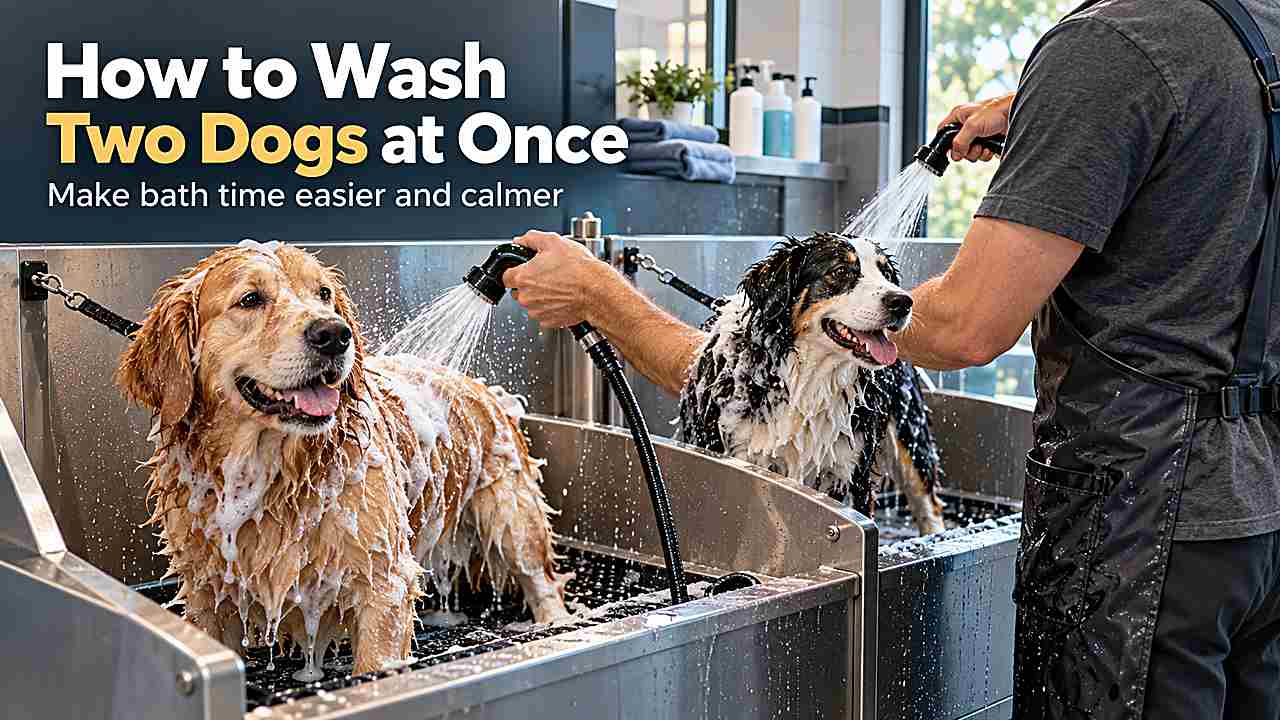
Washing two dogs in one trip sounds efficient, especially when both came home muddy or both need regular grooming. The challenge is that a wet dog can slip, jump, shake, tangle leashes, or react to another dog while your attention is on shampooing the second animal.
The safest setup usually treats the visit as one shared trip rather than one simultaneous bath. Some well-matched dogs can be managed together in a large station, but many pairs are easier and safer when one dog is washed while the other waits securely with another person.
Two dogs can share a pet-wash visit, but simultaneous washing only works when the station is large, both dogs are calm together, and a handler can supervise each dog continuously. Sequential baths are often safer.
Start by deciding whether the dogs should actually share the tub
The relationship between the dogs matters more than whether they live in the same home. Dogs that play well in the yard can still become tense when they are confined, wet, startled by a dryer, or competing for the handler’s attention.
Size is another practical issue. Two small dogs may fit comfortably in a large tub, while two large dogs can crowd each other into the walls and make stable footing difficult.
Any history of guarding, snapping during grooming, panic around water, or dislike of close restraint is a strong reason to bathe separately. A pet wash is a poor place to test whether two dogs will tolerate forced proximity under stress.
Two handlers make the visit dramatically easier
With one responsible adult per dog, each animal can remain supervised from arrival through drying. One person can wash while the other manages the waiting dog, prepares towels, or begins brushing, and the roles can switch without leaving either dog unattended.
A single handler has to divide attention whenever both dogs are attached in the wash area. That is where tangled grooming loops, surprise jumps, and conflicts over treats become more likely.
If only one person is available, sequential bathing is usually the safer plan. The waiting dog should be secured outside the tub in a place allowed by the facility rather than tied to a fixture and ignored while the other dog is washed.
The station layout determines whether simultaneous washing is realistic
A wide walk-in tub with multiple secure attachment points offers more options than a narrow raised tub designed for one dog. The floor outside the tub also needs enough space for towels, supplies, and a handler to move without stepping over leashes.
The dryer area can become even more complicated because airflow, loose hair, and noise may excite both dogs at once. Separate drying positions are preferable when the facility has them, especially for dogs that dislike air blowing toward the face.
Facility rules come first. Some businesses limit tubs to one dog at a time for safety, sanitation, or equipment reasons, so asking before arrival avoids planning around a setup that is not permitted.
A shared visit works best with a simple order
The easiest way to save time is not necessarily washing both dogs side by side. Efficiency often comes from preparing both dogs first, bathing them one at a time, and using the waiting period for brushing or towel setup.
This approach keeps the handler focused on one wet dog while still making the overall trip productive. It also allows shampoo and drying choices to match each coat instead of forcing both dogs through the same routine.
1. Brush and organize both dogs before the first bath
Loose hair and small tangles are easier to manage before the coat is wet. Brushing both dogs at the start also reveals whether one has mats, sore skin, burrs, or other issues that will change the plan.
Supplies can then be separated so each dog has a towel, brush, and any individual shampoo ready. Color-coded towels or small bags are useful when one dog has medicated products that should not be mixed with the other dog’s routine.
The waiting dog should already have a secure plan before water starts. Deciding where that dog will stand or who will supervise it prevents last-minute leash improvisation once the first dog is wet.
2. Wash the calmer or easier dog first when possible
Starting with the dog that moves smoothly through the bath gives the household a chance to settle into the station. The second dog may also benefit from watching a familiar companion experience the sprayer and dryer without distress.
There are exceptions. If one dog becomes more anxious while waiting, it may be better to wash that dog first so nervous energy does not build for thirty minutes outside the tub.
The choice should reflect the dogs you actually have rather than a fixed rule. A predictable sequence matters, but emotional state matters more than which dog is technically “first.”
3. Keep treats, leashes, and wet equipment separated
Two dogs create twice as many opportunities for tangles and competition. Leashes should stay clear of the tub floor, and treats should be delivered in a way that does not encourage one dog to crowd or guard the other.
Wet towels can be dropped directly into a waterproof bag instead of piling up near the dry equipment. Brushes that have collected dirty wet hair should also stay separate from tools that have not been used yet.
Small organizational habits reduce the mental load on the handler. When the area stays orderly, it is easier to notice a dog stepping backward, becoming restless, or trying to reach the other animal.
Do not force both dogs to share the same pace
Two dogs from the same home may have completely different coat and behavior needs. A short-haired dog may be finished while a double-coated companion still needs twenty minutes of drying, and a confident dog may tolerate a dryer that frightens the other one.
Trying to keep them synchronized can create unnecessary stress. One dog can be towel-dried and moved to a safe waiting area while the other continues, provided the facility allows it and supervision remains adequate.
The purpose of bringing both dogs together is convenience, not identical treatment. The visit stays safer when each dog can receive the amount of washing, rinsing, and drying that its own coat and temperament require.
Know when the shared visit is no longer worth it
A dog that repeatedly pulls toward the other, guards treats, snaps when crowded, or becomes more distressed as the second dog moves nearby is telling you the arrangement is too difficult. Continuing for the sake of saving a trip can turn a grooming problem into a safety problem.
Space limitations are another clear reason to split the baths. If handlers cannot move around the tub without stepping over dogs or equipment, the setup is not genuinely efficient even if both animals technically fit.
Separate visits may also be kinder for very different dogs, such as a frail senior paired with a young high-energy dog. Convenience should never depend on making one dog tolerate an environment that is harder simply because the other dog is present.
Cleanup takes longer with two dogs, so plan for it
Two coats produce more loose hair, more wet towels, and more water on the floor. Leaving a station clean is part of using a shared facility responsibly, and cleanup is easier when the handler has already separated dirty tools and contained wet towels.
The dogs should be secured before the final floor wipe or equipment check begins. A freshly washed dog wandering loose while the handler cleans is an easy way to end with another muddy paw print or an unsafe dash toward the door.
A quick reset of brushes and towels at home also matters. Two dogs can fill grooming tools with hair quickly, so cleaning and drying the equipment after the visit keeps the next shared trip from starting with dirty supplies.
Travel and waiting arrangements deserve a plan of their own
The dog that is not currently in the tub still needs a comfortable, supervised place to wait. A second adult can take that dog outside for a short walk or keep it settled in a permitted waiting area rather than leaving it tied to a wall fixture.
Cars are not automatically safe waiting rooms, particularly in warm or cold weather. If one dog must wait in the vehicle, temperature, ventilation, security, and the length of the wait all have to be appropriate, and many owners will find it easier to bring another handler instead.
Thinking through the waiting period before leaving home prevents the shared trip from becoming stressful halfway through. The best plan gives each dog a clear place to be at every stage, including arrival, washing, drying, and cleanup.
Whether two dogs should share one wash session also depends on how they influence each other. Some bonded dogs become calmer when they can see their companion, while others become competitive, vocal, or difficult to position in a confined area. The handler’s attention is another practical limit because a wet dog can move quickly when a gate opens or a dryer starts. In many cases, washing one dog while the second waits securely with another adult is simpler than trying to control both in the tub. Efficiency matters, but it should never come at the expense of safe restraint, complete rinsing, or each dog’s ability to stay settled.
Frequently Asked Questions
These questions cover the practical details that often come up after the main routine is clear. The answers are designed to help readers make a safer decision without turning a simple wash into a complicated project.
Can two dogs be in the same self-serve wash tub?
Some large tubs can physically accommodate two small or medium dogs, but facility rules and the dogs’ behavior matter more than space alone. Both animals need secure footing and enough room to avoid being pressed against each other.
If either dog becomes tense, tries to escape, or guards space, separate baths are safer. A shared tub is an option only when the environment remains calm and manageable.
Is it faster to wash both dogs at the same time?
Not always. Simultaneous washing can actually slow the process when the handler has to manage tangled leashes, repeated shaking, different coat needs, or competition for attention.
Preparing both dogs together and washing them sequentially often saves time without dividing supervision. The most efficient arrangement is the one that keeps each stage organized rather than literally happening at the same second.
What if one dog hates the dryer and the other does not?
They do not need identical drying routines. The dog that tolerates airflow can be dried normally, while the more sensitive dog may be towel-dried more thoroughly and introduced to lower airflow or finished at home.
Forcing the nervous dog to match the confident dog can create a negative association with the entire station. Individual handling is more important than keeping both dogs on the same schedule.
Should I bring two sets of towels and brushes?
Two clean towels are helpful because the first dog can saturate a towel quickly, and separate towels prevent one animal from inheriting dirt or medicated residue from the other. Brushes can sometimes be shared between healthy dogs in the same household if they are suitable for both coats and kept clean.
Medicated products, skin infections, or very different coat types make separate tools a better choice. Labeling or color-coding supplies can keep the visit organized.
Can one person safely manage two dogs at the pet wash?
It depends on the dogs, but one person usually has a much easier time bathing sequentially rather than trying to supervise two wet dogs at once. The waiting dog still needs a secure, permitted place where it cannot tangle, escape, or interfere with the active bath.
Large, anxious, reactive, or mobility-limited dogs are strong reasons to bring a second adult. Extra supervision is more valuable than trying to prove the visit can be done solo.
Conclusion
Washing two dogs at once at a pet wash can be efficient when the dogs are calm together, the station has enough space, and supervision never becomes divided. For many households, however, the best version of a “two-dog wash” is one trip with two organized, sequential baths.
Safety and cooperation should decide the format. If sharing the space creates crowding, tension, or frantic handling, separating the dogs will usually be faster in practice and much easier to repeat next time.